By Dr. Vishakha Iyer, Dermatologist & Aesthetic Medicine Specialist · Published 22 April 2026 · Last updated [1st Oct 2026]
The best acne scar treatment depends on your scar type. Depressed (atrophic) scars usually respond best to a combination, such as MNRF with subcision or a peel, while raised scars need a different approach altogether. In Bangalore, clinics publish per-session prices from about ₹1,500 to ₹25,000, depending on the treatment. A full-face MNRF course at our clinic is ₹24,000 to ₹48,000.
Acne scars are one of the most common reasons people come to see me, and one of the most misunderstood. Most patients have already spent months on serums and home remedies with little to show for it. That’s not because scars can’t be treated. It’s because the wrong treatment for the wrong scar gets you nowhere, so this guide starts with identifying your scar type.
| Key Takeaways – Flat brown acne marks a few shades darker than your skin usually fade within 6 to 12 months, though deeper ones can take years (AAD). True scars don’t fade on their own. – Ice pick scars make up about 60–70% of depressed acne scars, boxcar 20–30% and rolling 15–25% (Connolly et al., 2017). Each responds to different treatments. – MNRF carries a lower pigmentation risk than fractional CO₂ laser (Argobi et al., 2026; Sriram et al., 2024), but not zero: 5 of 31 patients developed temporary darkening in an Indian MNRF study (Chandrashekar et al., 2014). – Most people get partial, not complete, improvement. MNRF alone typically gives mild to moderate (25–50%) improvement in skin of colour; combinations do better (Gupta et al., 2020). – Published Bangalore prices run from about ₹1,500 to ₹25,000 per session depending on the treatment. Plan for a course: anywhere from 2 to 6 or more sessions, depending on how severe the scarring is. |
Acne marks vs acne scars: not the same thing
Acne marks are flat discoloured patches, and acne scars are changes in the skin’s structure. The difference decides your treatment, so I explain it to almost every patient.
Acne marks are flat spots left after a pimple heals: red or pink marks (post-inflammatory erythema, more common in lighter skin) or brown marks (post-inflammatory hyperpigmentation, or PIH, more common in darker skin) (DermNet). They’re a colour change, not damage to the skin’s structure. A brown spot a few shades darker than your natural skin colour usually fades within 6 to 12 months, while deeper discolouration can take years (American Academy of Dermatology).
Acne scars are permanent changes caused by collagen loss or excess collagen beneath the surface (DermNet). They don’t fade with time.
This matters because aggressive treatment on marks alone is unnecessary and can make pigmentation worse. Real scars, on the other hand, won’t respond to waiting or skincare. An in-person skin assessment tells you which you have.
Types of acne scars
Acne scars fall into two groups: depressed (atrophic) scars and raised (hypertrophic or keloid) scars. Depressed scars are far more common.
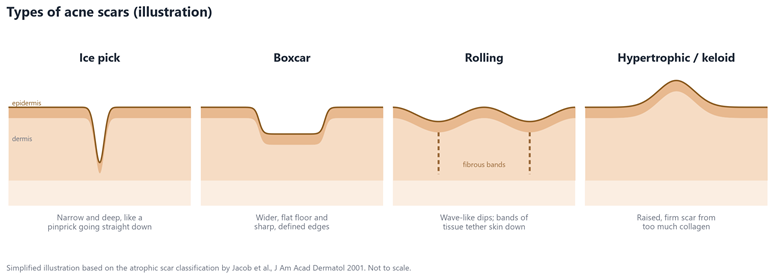
Types of acne scars. Alt text: “Illustrated skin cross-sections of four acne scar types: ice pick (narrow and deep), boxcar (flat floor, sharp edges), rolling (wave-like, tethered by fibrous bands) and hypertrophic or keloid (raised).”
Depressed (atrophic) scars
Depressed scars form when the skin loses collagen as it heals. A widely used classification divides them into three types (Connolly et al., J Clin Aesthet Dermatol, 2017):
- Ice pick scars are narrow and deep, like a pinprick going straight down. They make up about 60–70% of atrophic scars and are the hardest to treat because of their depth.
- Boxcar scars are wider, with a flat floor and sharp edges. They make up about 20–30% and respond well to resurfacing.
- Rolling scars have soft, sloping edges that make the skin look wavy. They make up about 15–25% and are caused by fibrous bands tethering the skin to deeper tissue.
These percentages are approximate and overlap, because most people have a mix of types.
Raised (hypertrophic and keloid) scars
Raised scars form when the skin makes too much collagen as it heals. Hypertrophic scars stay within the original spot, while keloids spread beyond it. Keloids from acne appear more often along the jawline, chest and upper back, and keloids and post-acne pigmentation are both more common in skin of colour (DermNet). Raised scars need a completely different plan. Options include steroid injections into the scar repeated every few weeks, silicone and pressure treatments, cryotherapy and laser (DermNet). Cutting a keloid out on its own can cause a larger one to grow back, which is why it’s combined with other treatment. See our keloid and minor skin procedures page.
What causes acne scars?
Deep, inflamed acne is the main cause, and it’s the one you can do most about. Not every pimple leaves a scar. The main risk factors are:
- Severe inflammation. Deep cysts and nodules damage more collagen than whiteheads or blackheads. Getting acne under control early is the best prevention (see what causes acne in Bangalore).
- Picking and squeezing. It pushes inflammation deeper and raises the chance of a scar.
- Delayed treatment. The longer active acne goes on, the more cycles of damage occur.
- Genetics. Some people scar more easily, however careful they are.
- Skin tone. Darker skin is more prone to PIH and keloids, which affects which treatments are safest.
Which treatment for which scar?
Match the treatment to the scar type. Most people have a mix, so most plans combine two or more treatments. The table summarises the evidence and what I see in practice.
| Scar type | Best options | Typical course | Downtime | Pigmentation risk in darker skin |
| Rolling | Subcision, MNRF, fillers | 1–3 subcision sessions plus 3–6 MNRF | Bruising for a few days after subcision | Low to moderate |
| Boxcar | MNRF, fractional CO₂ laser, medium-depth peels | 3–6 MNRF sessions (4–6 often needed), or laser | MNRF: back to work next day. CO₂: about 5 days | MNRF lower; CO₂ higher |
| Ice pick | TCA CROSS (a chemical peel technique), MNRF, punch techniques | About 4 TCA CROSS sessions | Short; depends on peel strength | Moderate |
| Shallow scars and marks | Superficial peels, topical retinoids | 3–5 peels | Little to none | Low with a suitable peel |
| Raised (hypertrophic, keloid) | Keloid treatment | Varies | Varies | Higher keloid tendency |
Sources for the table: Sriram et al., J Cutan Aesthet Surg, 2024; Gupta et al., 2020; Vaishnani, 2008; Khunger et al., 2011; AAD.
Acne scar treatments in detail
MNRF (microneedling radiofrequency)
MNRF is the treatment I recommend most often for rolling and boxcar scars in Indian skin. It delivers radiofrequency energy through fine needles into the dermis, the layer where scarring happens, and new collagen gradually lifts the depressions over the following months.
Evidence:
- In an Indian study of 31 patients with skin types III to V (on the Fitzpatrick scale, light brown to dark brown skin), 80.6% improved by two scar grades after four sessions six weeks apart (Chandrashekar et al., J Cutan Aesthet Surg, 2014).
- A 2020 review of treatments in skin of colour found that most patients get mild to moderate (25–50%) improvement with MNRF alone (Gupta et al., J Cutan Aesthet Surg, 2020).
Downtime and risks: Expect redness and swelling for a day or two. Most people go back to work the next day (Sriram et al., J Cutan Aesthet Surg, 2024). Pigmentation risk is lower than with fractional CO₂ laser, but it isn’t zero. In the 2014 study, five of 31 patients developed post-inflammatory hyperpigmentation.
Best for: rolling and boxcar scars, mild to moderate ice pick scars, and darker skin tones. For how it compares with a derma roller, see our MNRF vs derma roller comparison.
Chemical peels and TCA CROSS
Chemical peels work best for shallow scars, uneven texture and acne marks. A controlled acid removes damaged outer layers and stimulates renewal underneath.
For ice pick scars, a technique called TCA CROSS applies a strong acid only inside each scar. In an Indian study of 30 patients with darker skin (types IV and V), 73.3% had more than 70% improvement after four sessions (Khunger et al., J Cosmet Dermatol, 2011).
Downtime and risks: Superficial peels are considered safe in skin of colour and can soften shallow scars over several sessions (Gupta et al., 2020). The AAD notes that mild peels may need 3 to 5 treatments (AAD). The wrong strength can cause pigmentation in Indian skin. In the TCA CROSS study, two patients developed hyperpigmentation and one hypopigmentation, which is why we prepare the skin first and choose the peel carefully.
Best for: acne marks, surface texture, mild boxcar scars (superficial peels) and ice pick scars (TCA CROSS). See all options on our chemical peel treatment page.
Fractional CO₂ laser
Fractional CO₂ laser resurfaces the skin and stimulates collagen deep down. It can give the strongest improvement, but it carries the highest pigmentation risk in darker skin.
Evidence: A 2026 meta-analysis of eight randomised trials (249 patients) found that CO₂ laser improved scars slightly more than MNRF. It also had a higher risk of post-inflammatory hyperpigmentation (risk ratio 4.44), more pain and longer redness (Argobi et al., J Cosmet Dermatol, 2026). In skin types IV and V, studies report PIH in anywhere from 6.4% to 92.3% of patients, depending on settings (Gupta et al., 2020).
Downtime and risks: In an Indian comparison, people needed about five days off after CO₂ laser (Sriram et al., J Cutan Aesthet Surg, 2024). Conservative settings, skin preparation and strict sun protection lower the risk.
Best for: deeper boxcar scars and skin resurfacing, in carefully selected patients. See our laser skin treatment page for the lasers we use.
Subcision for rolling scars
Subcision releases the fibrous bands that pull rolling scars down. A fine needle is passed under the skin to cut the bands, so the skin can lift.
Evidence: In an Indian study of 15 patients treated with a 24G needle, scar improvement ranged from 40% to 80% (Vaishnani, Indian J Dermatol Venereol Leprol, 2008).
Downtime and risks: Every patient had swelling and bruising. The swelling settled by the second day, and in all but two patients the bruising started fading after the third day. Other reported risks are bleeding, infection and the depression returning (Connolly et al., 2017). We often combine subcision with MNRF so the released area rebuilds collagen. [Clinic to confirm: subcision offered at Cheveuderm.]
Best for: rolling scars. It’s less useful for ice pick or boxcar scars.
Dermal fillers for acne scars
Hyaluronic acid fillers lift depressed scars instantly by adding volume underneath. The results are temporary.
Evidence: In a small randomised split-face trial (15 people), a hyaluronic acid filler cut the number of atrophic scars by 65%, compared with 15% on the saline side, at 90 days. All minor side effects had resolved by day 30 (Siperstein et al., J Cosmet Dermatol, 2022). Most fillers last from 3 months to 2 years (AAD).
Best for: individual deep rolling scars, a quick improvement before an event, or topping up other treatments. See our dermal fillers page.
Punch excision and elevation for deep scars
For the deepest ice pick and boxcar scars, resurfacing treatments alone often don’t reach far enough. A 2020 review notes that the most severe scars improve poorly with resurfacing, and that punch excision and punch elevation can be tried (Gupta et al., 2020). In punch excision, the scar is cut out with a small round tool and stitched, swapping a deep pit for a fine line. In punch elevation, the scar’s floor is lifted up to the level of the surrounding skin. In my practice, we usually follow them with MNRF or laser to blend the area. [Clinic to confirm: punch techniques offered at Cheveuderm.]
Best for: isolated deep ice pick or boxcar scars.
Home treatments: what they can and can’t do
Topical products help marks and mild scarring, but they can’t rebuild deep scars. The AAD says a retinoid or salicylic acid can make mild scarring less noticeable (AAD). In a 24-week trial in 67 people with active acne, a prescription adapalene and benzoyl peroxide gel reduced the total atrophic scar count by 15.5%, while scars increased by 14.4% with the placebo gel (Dréno et al., Am J Clin Dermatol, 2018).
That’s a real but modest effect. Topicals are worth using to treat acne, fade marks and protect results. For visible pitted scars, you’ll need a clinical treatment as well.
Cost of acne scar treatment in Bangalore
Published per-session prices in Bangalore range from about ₹1,500 to ₹25,000, with peels and subcision at the low end and fractional CO₂ laser at the top. The table shows Cheveuderm’s prices alongside ranges that other Bangalore clinics publish on their websites, checked on 30 September 2026. Those are city-wide ranges, not necessarily each clinic’s own fees, and they change.
| Treatment | Cheveuderm (HBR Layout) | Ranges published by other Bangalore clinics (per session) |
| MNRF | ₹8,000 to ₹15,000 per session (single area); ₹24,000 to ₹48,000 for a 3–4 session full-face course | ₹4,000 to ₹20,000 (Other Clinics) |
| MNRF + PRP | ₹14,000 to ₹22,000 per session | Not compared |
| Chemical peel | [₹ ____] per session | Superficial ₹2,000 to ₹4,000; medium ₹4,000 to ₹7,000 or more |
| Fractional CO₂ laser | [₹ ____] per session | ₹6,000 to ₹25,000 |
| Subcision | [₹ ____] per session | ₹2,000 to ₹7,500 at most clinics, ₹1,500 to ₹18,000 overall |
| Dermal fillers | [₹ ____] per session | ₹11,000 to ₹21,000 per session |
Published acne scar treatment prices per session in Bangalore. Alt text: “Range chart of published per-session prices in Bangalore: MNRF about ₹4,000 to ₹20,000 (Cheveuderm ₹8,000 to ₹15,000), chemical peels ₹2,000 to ₹7,000, fractional CO2 laser ₹6,000 to ₹25,000, subcision ₹2,000 to ₹7,500 and fillers ₹11,000 to ₹21,000.”
The total depends on how many sessions and treatments you need. Our full-face MNRF course of three to four sessions is ₹24,000 to ₹48,000. Some people need more: a 2020 review notes that MNRF usually needs 4–6 sessions for the best results (Gupta et al., 2020), and adding subcision or a peel adds to the total. At your assessment we’ll give you a written plan with the total cost.
How many sessions, and what results to expect
Most people need several sessions and see partial, not complete, improvement. From what I see in practice:
- Mild scarring (a few shallow scars, mostly marks): 2 to 3 sessions, often with good improvement.
- Moderate scarring (boxcar and rolling scars over larger areas): 4 to 6 sessions, with visible change after the second or third.
- Severe or deep scarring (widespread pitting, mostly ice pick): a combination plan over 6 or more sessions. Significant improvement is realistic; complete removal isn’t always possible.
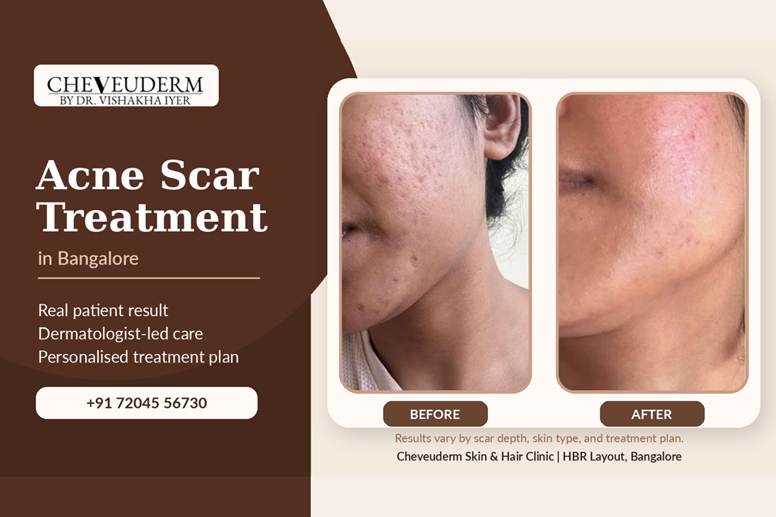
Real patient result. Alt text: “Before and after acne scar treatment at Cheveuderm, Bangalore: a patient’s cheek with depressed acne scars, and the same cheek after treatment with smoother texture.”
The research backs up setting expectations this way. Combining treatments usually beats using one alone. In one trial summarised in a 2020 review, PRP (platelet-rich plasma from your own blood) plus microneedling averaged about 65% improvement, against about 28% for microneedling alone (Gupta et al., 2020). We offer a related combination, MNRF with PRP. In an Indian study combining subcision and microneedling, 95.6% of patients improved by at least one grade, and most (55.5%) rated their improvement at 25% to 49% (Bhargava et al., J Clin Aesthet Dermatol, 2019).
Collagen takes time to rebuild, so improvement continues for months after each session. The people who get the best results finish the full course and look after their skin in between.
Who should wait, or choose a different treatment
Some situations call for waiting or a gentler option. Tell your doctor if any of these apply to you:
- Active acne. Get it under control first, or treat it alongside the scars. New breakouts mean new scars.
- Recent or current isotretinoin. You may not need to wait as long as people used to think. An Indian guideline from the Association of Cutaneous Surgeons of India considers fractional radiofrequency microneedling, fractional lasers and superficial and medium-depth peels safe during or soon after isotretinoin (Mysore et al., J Cutan Aesthet Surg, 2017). A US expert consensus also found insufficient evidence to justify delaying fractional laser procedures and superficial peels. It does not recommend mechanical dermabrasion or fully ablative laser during isotretinoin treatment (Spring et al., JAMA Dermatology, 2017). Your doctor will decide based on your dose and skin.
- A tendency to keloids. This is more common in darker skin and on the jawline, chest and back (DermNet). It changes which treatments are safe.
- A skin infection, cold sores or a recent tan in the area to be treated.
Open pores vs acne scars
Open pores aren’t scars, although people often mistake one for the other. Pores are enlarged follicle openings linked to oil, ageing and past congestion, and they respond to different treatments. Our guide to open pores on your face explains how to tell them apart.
Frequently asked questions
Are acne scars permanent?
Yes, true scars don’t heal on their own because the change is structural (DermNet). But permanent doesn’t mean untreatable. The right combination of treatments can make them much less visible.
Can acne scars be removed completely?
Rarely. Most studies report partial improvement. MNRF alone typically gives mild to moderate (25–50%) improvement in skin of colour, and combinations do better (Gupta et al., 2020). Deep ice pick scars are the hardest to clear fully.
What is the best treatment for acne scars in Indian skin?
There’s no single best treatment; it depends on your scar type. MNRF is the one I recommend most often for rolling and boxcar scars in Indian skin because its pigmentation risk is lower than fractional CO₂ laser, both in pooled trials (Argobi et al., 2026) and in an Indian comparison (Sriram et al., J Cutan Aesthet Surg, 2024), though not zero.
How much does acne scar treatment cost in Bangalore?
Published prices range from about ₹1,500 to ₹25,000 per session, depending on the treatment. A full-face MNRF course at our clinic is ₹24,000 to ₹48,000 for three to four sessions, and more if you need extra sessions. See the cost table above for each treatment.
How long until I see results?
In my experience, most people notice a change within six to eight weeks of their first session, and improvement continues for several months as new collagen forms. Plan on judging results after the full course, not after one session.
Will new pimples cause new scars?
Yes. Ongoing acne means an ongoing risk of new scars. That’s why we treat active acne and scars together.
Book an acne scar assessment
The most useful first step is an assessment to identify your scar types, check for active acne and plan treatment around your skin tone. You’ll leave with a written plan, the number of sessions and the total cost.
Book an acne scar consultation or explore all our skin and face treatments in Bangalore.
Dr. Vishakha Iyer, Dermatologist & Aesthetic Medicine Specialist, Cheveuderm, HBR Layout, Bangalore. MBBS (Bharati Vidyapeeth, Pune); Diploma in Practical Dermatology (Cardiff University); Diploma in Aesthetic Medicine (AAAM). Dr. Iyer treats acne and acne scars, including MNRF, chemical peels and combination scar programmes, at the clinic. Read her full profile.
This article is for general information and isn’t a substitute for a medical consultation. Prices from other clinics are as published on their websites on the retrieval date and may have changed. Results vary from person to person.