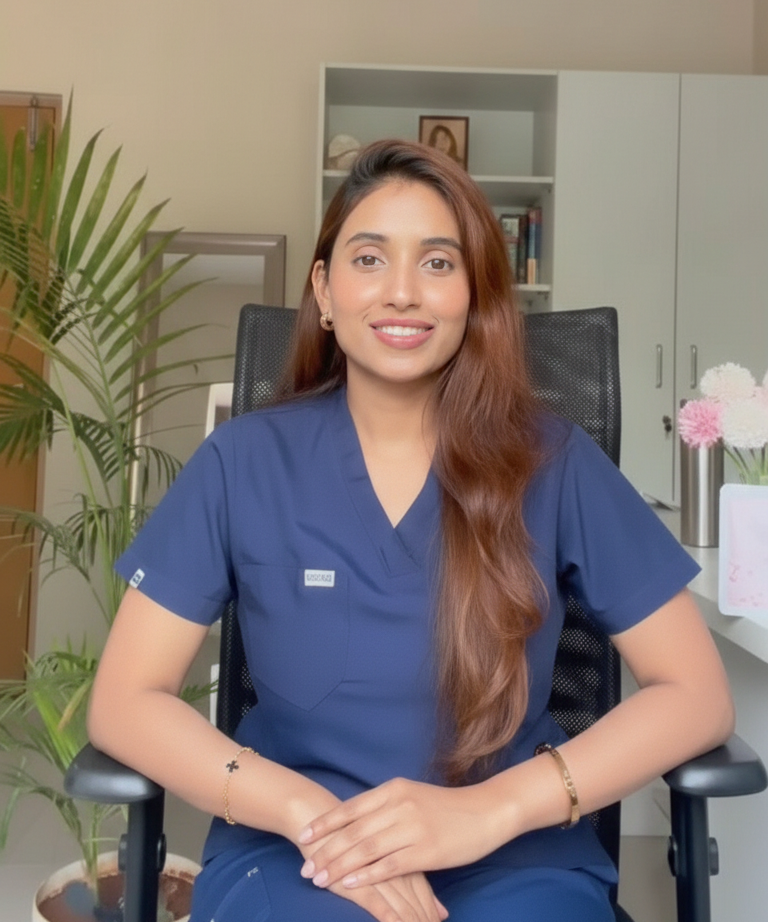
By Dr. Vishakha Iyer, Dermatologist and Aesthetic Medicine Specialist, Cheveuderm Skin & Hair Clinic, HBR Layout, Bengaluru
Most hair transplant side effects are mild and expected: swelling, redness, small crusts, some soreness and a temporary shedding of the new hairs. They usually settle within two weeks. Serious problems such as infection are rare, and most bad results come from poor planning, not from the surgery itself.
This guide explains every side effect you’re likely to hear about, how long each one lasts, what recovery looks like month by month, and whether the result is really permanent. If you’re already weighing up the procedure, our hair transplant in Bangalore page covers techniques, graft counts and cost.
Hair transplant at a glance
• Procedure: one day, under local anaesthesia; you go home the same day
• Back to desk work: most people in 3–5 days (the NHS suggests allowing 1–2 weeks off)
• Shedding of transplanted hairs: weeks 2–4, which is normal
• New growth: from month 3–4
• Final result: month 9–12
• Permanent? Yes, the moved hair keeps growing
Is a hair transplant permanent?
Yes. For most people the transplanted hair is permanent.
The grafts come from the back and sides of your scalp. Hair in that area is naturally resistant to DHT, the hormone that causes pattern baldness. The follicles keep that resistance after they are moved, so they keep growing in their new place for life. This is called donor dominance. It was first shown by Dr. Norman Orentreich in 1959 (Annals of the New York Academy of Sciences) and every modern transplant relies on it.
There is one thing a transplant can’t stop. Your own hair around the transplant can still thin as you get older. That is why the hairline should be designed for how you will look at 45 and 60, not only next year, and why many people protect their remaining hair with PRP or GFC hair treatment or medicines prescribed by their doctor.

Hair transplant side effects at a glance
| Side effect | How common | Usually lasts | What helps |
|---|---|---|---|
| Swelling of the forehead, sometimes around the eyes | Common | 2–5 days | Sleep with your head raised for the first 3–5 nights |
| Redness and small crusts on the grafts | Almost everyone | 7–10 days | Gentle washing from day 3, using the method you’re shown |
| Soreness or tightness in the donor area | Common | 2–3 days | Prescribed pain relief |
| Itching | Common | 1–2 weeks | Prescribed spray; don’t scratch |
| Numbness in patches of the scalp | Common | A few weeks to a few months | Settles on its own |
| Shedding of transplanted hairs (“shock loss”) | Expected | Weeks 2–4; regrows from month 3–4 | Patience: the roots are safe |
| Small pimples as new hairs grow (folliculitis) | Occasional | Months 2–4 | Simple treatment from your doctor |
| Bleeding | Uncommon | First day | Light pressure with clean gauze |
| Infection | Rare | – | Sterile technique and good aftercare |
The side effects people worry about most
Shock loss: why your new hair falls out
Two to four weeks after the procedure, most of the transplanted hairs fall out. This frightens people, but it is expected. The hair shaft sheds; the root stays alive under the skin and starts growing new hair from about month 3–4.
Sometimes a little of your own hair near the transplanted area sheds too. This is usually temporary, and it grows back over the following months.
Swelling
Swelling usually starts on day 2 or 3 and moves down the forehead, sometimes to the eyes. It looks dramatic but settles within a few days. Sleeping with your head raised and following your aftercare advice keeps it down.
Numbness
Small nerves in the scalp are disturbed when grafts are taken and placed. Patches of numbness or tingling are common and usually fade over a few weeks to a few months.
Folliculitis (small pimples)
As new hairs push through the skin, some people get small red bumps, a bit like acne. They are usually harmless and are treated simply. Don’t squeeze them; tell your doctor instead.
Scarring
FUE and DHI leave tiny dot-like marks in the donor area, not a line scar. They are usually hidden even with short hair. The older strip method (FUT) leaves a thin line scar across the back of the head (NHS).
Avoidable problems: why who plans it matters
Some disappointing results have nothing to do with bad luck:
- An unnatural, “drawn-on” hairline that is too low or too straight for your age.
- An over-harvested donor area, leaving the back of the head looking thin.
- Poor growth, from rough graft handling or grafts kept out of the body too long.
- Visible scarring, when too many grafts are taken close together.
- Running out of donor hair, because the plan didn’t allow for future hair loss.
The NHS suggests asking any clinic about the doctor’s experience, how many transplants they’ve done, how complications are handled, which technique they recommend and why, and what follow-up you’ll get. At Cheveuderm, your transplant is planned and supervised by Dr. Vishakha Iyer, who also treats the cause of your hair loss and reviews your result at each follow-up.
FUE, DHI or FUT: how recovery differs
| FUE | DHI | FUT (strip) | |
|---|---|---|---|
| How grafts are taken | One by one with a tiny punch | One by one, like FUE | A strip of skin is cut out |
| Donor scar | Tiny dots | Tiny dots | A thin line |
| Shaving | Usually needed | Often minimal | Only the strip area |
| Recovery | 7–10 days | Often a little faster at the implanted area | Longer; stitches in the donor area |
| Offered at Cheveuderm | Yes | Yes | No |
You can see the full FUE vs DHI comparison on our hair transplant page. Dr. Iyer recommends a technique after checking your hair loss and donor area.
Hair transplant recovery, month by month
| When | What to expect |
|---|---|
| Day 1–3 | Mild redness, swelling and small crusts. Completely normal. |
| Day 4–10 | Crusts clear, swelling settles, the donor area heals. Most people return to desk work. |
| Week 2–4 | Transplanted hairs shed. The roots stay safe under the skin. |
| Month 1–3 | A resting phase with little visible change. This is the hardest part: be patient. |
| Month 3–4 | New, permanent hair starts to grow. |
| Month 6–8 | Clear improvement in density and hairline. |
| Month 9–12 | The full result, and a final review with Dr. Iyer. |

Aftercare that lowers your risk
For the first 7 days:
- Don’t touch, scratch or rub the grafts.
- Sleep with your head raised for the first 3–5 nights.
- Start gentle washing from day 3, exactly as you’re shown.
- Use your prescribed spray and medicines as directed.
For the first 2–4 weeks:
- Skip hard exercise and heavy sweating for 2–3 weeks.
- Avoid swimming, saunas and steam rooms for 4 weeks.
- Wear a loose, soft cap outdoors, not a tight one.
- Don’t use oils or hair products that weren’t prescribed.
- Don’t smoke. It lowers the number of grafts that survive.
Living in Bangalore: most people ride a two-wheeler at some point, so ask Dr. Iyer when your helmet can safely go back on. It shouldn’t press on the grafts in the early weeks. If your area has hard water, follow the washing routine you’re given; our guide to hard water and hair fall in Bangalore explains why it matters.
When to call your doctor
Call the clinic straight away if you notice:
- Redness or swelling that spreads or gets worse after day 5.
- Pus, a bad smell, or increasing pain.
- A fever.
- Bleeding that doesn’t stop with 10–15 minutes of gentle pressure.
- Grafts that look dislodged, with fresh bleeding at the spot.
Who shouldn’t have a transplant yet
A transplant works best when hair loss has settled, usually from about age 25, and when there is enough healthy donor hair. The NHS notes it is suited to the inherited type of baldness, not to conditions such as alopecia areata.
Medical treatment usually comes first if:
- Your hair loss is early, or still changing quickly.
- Your hair loss is linked to thyroid problems, alopecia areata, low iron, a recent illness or chemotherapy.
- You are a woman with diffuse thinning all over the scalp, which needs a hormonal and medical check first.
For these, hair loss treatment in Bangalore or GFC and PRP is often the better first step. Dr. Iyer will tell you honestly which one you need.
How much does a hair transplant cost?
Hair transplant cost is calculated per graft, so your total depends on how many grafts you need and whether you have FUE or DHI (DHI costs more per graft).
| Your hair loss | Typical grafts | What it usually covers |
|---|---|---|
| Early recession | 1,000–1,500 | Hairline and temples |
| Moderate (most common) | 2,000–3,000 | Hairline plus crown |
| Advanced | 3,000–5,000 | Most of the top of the scalp |
| Extensive | 5,000+ | Staged over two sessions |
At Cheveuderm you get your exact graft count and a fixed, written quote at your scalp analysis, with no pressure to go ahead. See hair transplant cost in Bangalore for what the price includes. Planning a beard as well? Read about beard transplant; Dr. Iyer plans both together so your donor hair goes where it matters most.
Frequently asked questions
Does a hair transplant hurt?
It is done under local anaesthesia. You feel the numbing injections at the start, then mostly pressure. Mild soreness for 2–3 days afterwards is managed with prescribed medicine.
How long do I need off work?
Most people return to desk work in 3–5 days, once the crusts are fading. The NHS suggests allowing 1–2 weeks, which is sensible if your job is physical or you’d rather nobody notices.
Will people be able to tell?
In the first 7–10 days you’ll have some redness and small crusts. After that, a well-designed transplant blends with your own hair.
Can transplanted hair fall out again?
It sheds once, at weeks 2–4, then regrows from month 3–4 and keeps growing. Hair that was never transplanted can still thin with age.
Is there a scar?
FUE and DHI leave tiny dot-like marks in the donor area that are usually hidden even with short hair. There is no line scar.
Can women have a hair transplant?
Yes, for female pattern hair loss, traction alopecia and hairline correction, after a careful check of hormones and donor hair. Diffuse thinning often responds better to medical treatment.
Can I combine a transplant with PRP or GFC?
Yes. GFC or PRP is often used alongside a transplant to support healing and strengthen the existing hair around the grafts.
How many grafts will I need?
Roughly 1,000–1,500 for early recession, 2,000–3,000 for hairline plus crown, and 3,000–5,000 for advanced loss. Your exact count is confirmed at your scalp analysis.
Book a scalp analysis with Dr. Vishakha Iyer
Not sure whether you need a transplant, or whether medical treatment can still help? At a scalp analysis, Dr. Iyer checks your hair loss pattern, scalp health and donor density. You leave with your graft count, the right technique and a written quote.
Call or WhatsApp +91 72045 56730, or book a consultation online. Cheveuderm is at Plot no. 328, 4th Block, HBR Layout, Bengaluru 560043, close to Kalyan Nagar, Banaswadi, Hennur and Hebbal. Open Monday to Saturday 11 AM–7 PM and Sunday 11 AM–5 PM.
Read next: Hair transplant in Bangalore: FUE, DHI, cost and results · Beard transplant · GFC hair treatment explained
Sources
- NHS: Hair transplant
- Orentreich N. Autografts in alopecias and other selected dermatological conditions. Annals of the New York Academy of Sciences, 1959. PubMed
- NHS: Hair loss